

Janus-style catalyst turns seawater into two valuable chemicals at once
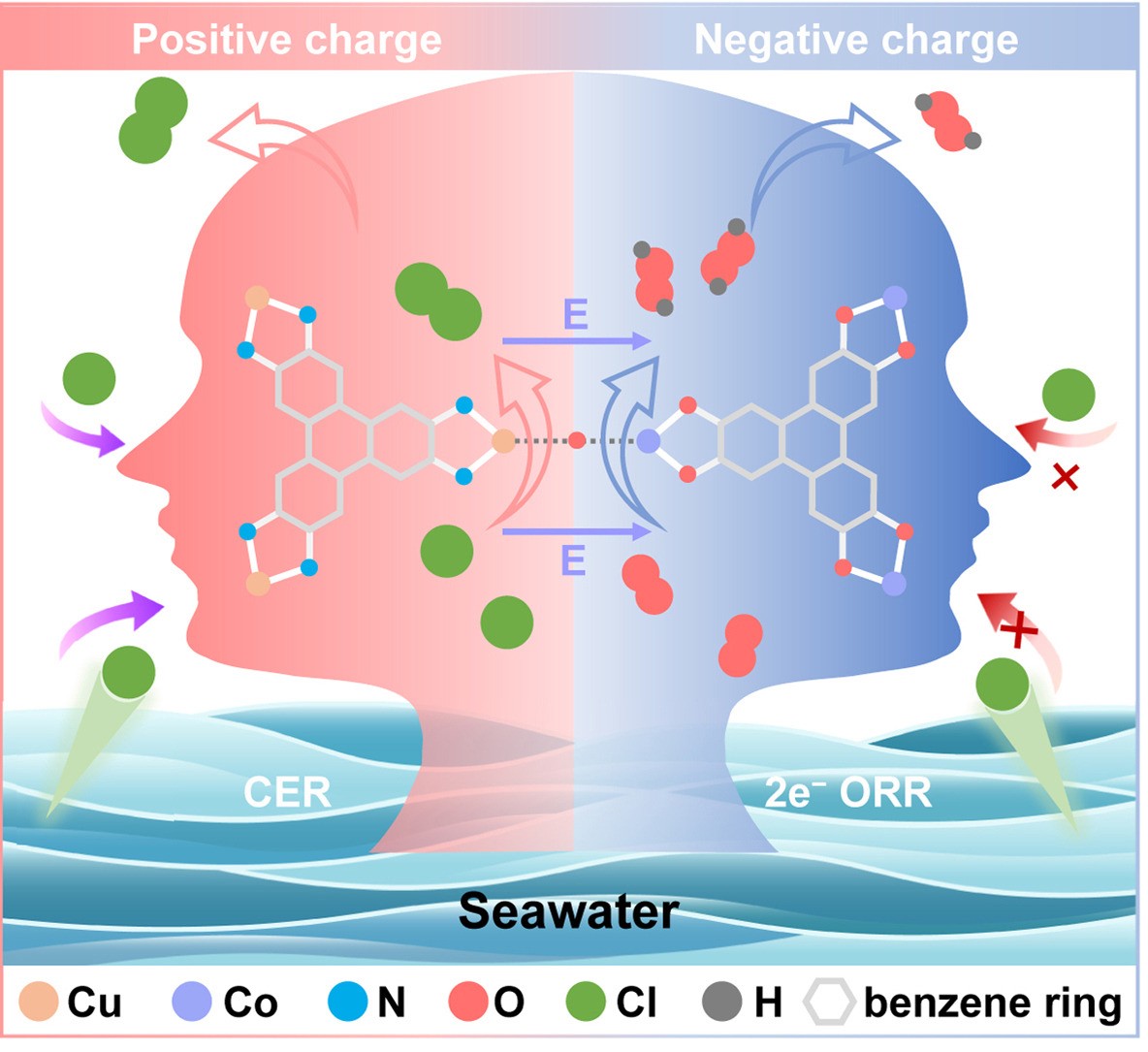
Schematic of the Cu-HITP@Co-HHTP Janus heterostructure. The positively charged Cu-HITP core (yellow) attracts chloride ions (Cl⁻, green) to drive the chlorine evolution reaction (CER) at the anode, while the negatively charged Co-HHTP shell (blue) repels
GA, UNITED STATES, September 24, 2026 /EINPresswire.com/ -- Seawater covers 97% of Earth’s water but remains largely untapped as a chemical feedstock. Now, researchers have developed a catalyst that turns seawater into two valuable products at the same time: hydrogen peroxide (H₂O₂), a versatile bleaching and disinfecting agent, and active chlorine, a widely used water treatment chemical. The catalyst, built from two conductive metal-organic frameworks joined together, uses oxygen from the air and chloride ions naturally present in seawater to drive both reactions simultaneously. This approach offers a more sustainable and energy-efficient route to producing these industrial chemicals without relying on freshwater or complex separation processes.
Hydrogen peroxide is one of the world’s most important chemicals, but its current production relies on an energy-intensive anthraquinone process that generates substantial waste. Electrochemical synthesis via the two-electron oxygen reduction reaction offers a cleaner alternative — yet in seawater, chloride ions tend to poison the catalyst surface, blocking active sites and lowering efficiency. Meanwhile, the chlorine evolution reaction can turn those same chloride ions into valuable active chlorine, but most existing systems pair oxygen reduction with oxygen evolution, a reaction that produces low-value O₂. Coupling the two-electron oxygen reduction with chlorine evolution in a single seawater electrolyzer would be ideal, but it demands a catalyst that can attract chloride ions at the anode while repelling them at the cathode — two opposing requirements that have made this goal elusive. Based on these challenges, a deeper investigation into catalyst architectures capable of resolving this conflict is urgently needed.
A team led by researchers at East China Normal University, in collaboration with The University of Queensland, Fuzhou University, and Shanghai University, reports a Janus conductive metal-organic framework-on-conductive-metal-organic framework heterostructure that enables simultaneous production of hydrogen peroxide (H₂O₂) and active chlorine by seawater electrolysis. The study, published on 1 September 2026 in eScience (Volume 6, Issue 5, Article 100581), demonstrates a bifunctional electrocatalyst that achieves high production rates and Faradaic efficiencies for both products.
The team constructed a core-satellite structure: positively charged Cu-HITP nanorods form the core, while negatively charged Co-HHTP nanoparticles grow on the surface. This design creates anisotropic surface charges — the Co-HHTP shell repels chloride ions at the cathode to protect the oxygen reduction active sites, while the Cu-HITP core attracts chloride ions at the anode to fuel the chlorine evolution reaction. At the interface between the two materials, Cu–O–Co chemical bonds form, generating distinct active sites with tailored electronic structures: cobalt sites preferentially adsorb O₂ for the two-electron oxygen reduction, while copper sites favor chloride adsorption for chlorine evolution. The different Fermi levels of the two frameworks drive electron transfer from Cu-HITP to Co-HHTP, creating a built-in electric field that enhances charge transfer across the heterointerface. In simulated seawater, the catalyst achieved a H₂O₂ selectivity of 99.1% and a chlorine evolution overpotential of only 38 mV at 10 mA cm⁻² — outperforming commercial dimensionally stable anodes. In an integrated electrolyzer using real seawater from the Bohai Sea, the system delivered production rates of 9.34 mol g_cat⁻¹ h⁻¹ for H₂O₂ and 9.26 mol g_cat⁻¹ h⁻¹ for active chlorine, with Faradaic efficiencies of 95.1% and 94.3%, respectively. The catalyst maintained stable performance for over 100 hours with minimal decay.
“This is really about letting seawater work for us in a smarter way,” the authors said. “Seawater is abundant, but using it for electrolysis has always been tricky because chloride ions both poison the cathode and serve as the reactant at the anode. Our Janus design resolves this contradiction by giving each side of the catalyst a different job — one side repels chloride, the other attracts it. The result is a system that produces two high-value chemicals simultaneously, with efficiency that rivals or exceeds many freshwater-based approaches. We think this opens a practical pathway for coastal regions to turn seawater into a local chemical manufacturing resource.”
The in situ generated H₂O₂ and active chlorine (primarily HClO) were tested for real-world applications. Both solutions decolorized organic dye pollutants — including methyl orange, methyl red, and methylene blue — within five minutes, demonstrating strong oxidative capability for wastewater remediation. In antibacterial tests against Escherichia coli, the electrolysis products created clear inhibition zones, with radii expanding from 20.0 mm to 44.9 mm as electrolysis time increased from 5 to 60 minutes, confirming concentration-dependent disinfection efficacy. The ability to produce both a bleaching agent and a disinfectant directly from seawater — using only oxygen and electricity — could enable decentralized chemical production in coastal and island communities, reducing the need for transporting hazardous chemicals and offering a sustainable solution for on-site water treatment and sterilization.
References
DOI
10.1016/j.esci.2026.100581
Original Source URL
https://doi.org/10.1016/j.esci.2026.100581
Funding Information
National Natural Science Foundation of China (Grant Nos. 22572056, 22475072, 22273023, 92477103); Natural Science Foundation of Shanghai (Grant Nos. 25ZR1402122, 23ZR1418200); Shanghai Municipal Science and Technology Commission (Grant No. 25511102400); Natural Science Foundation of Chongqing (Grant No. CSTB2023NSCQ-MSX0616); Fundamental Research Funds for the Central Universities.
Lucy Wang
BioDesign Research
email us here
Legal Disclaimer:
EIN Presswire provides this news content "as is" without warranty of any kind. We do not accept any responsibility or liability for the accuracy, content, images, videos, licenses, completeness, legality, or reliability of the information contained in this article. If you have any complaints or copyright issues related to this article, kindly contact the author above.
