

New Niskanen Center research examines how VA strengthened its capacity to deliver, and what other agencies can learn
A ten-year VA study finds that lasting service improvements came from adopting the product model agency-wide, not from technology alone.
Agencies deliver better when they have the governance, funding, teams, and feedback systems to adapt and improve over time.”
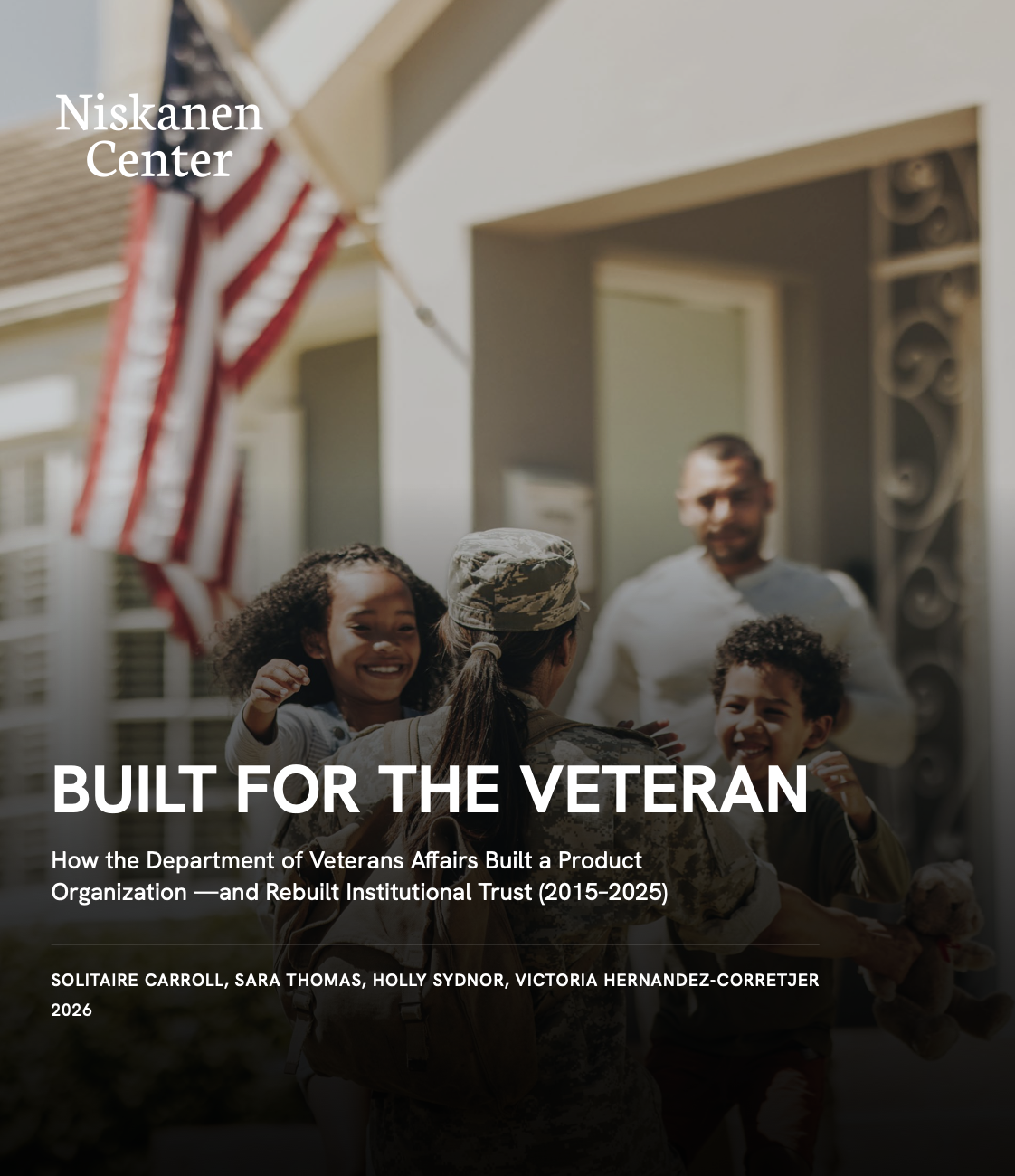
WASHINGTON, DC, UNITED STATES, September 24, 2026 /EINPresswire.com/ -- The Niskanen Center today released Built for the Veteran: How the Department of Veterans Affairs Built a Product Organization — and Rebuilt Institutional Trust (2015–2025), a case study examining a decade of institutional change at the Department of Veterans Affairs, along with Built to Deliver: A Product at Scale Playbook for Digital Modernization, a practical guide for government leaders.— Solitaire Carroll, Senior Researcher and Strategic Advisor
The case study traces how VA moved from the institutional crisis exposed by the 2014 Phoenix wait-time scandal toward a sustained capacity to deliver across three presidential administrations. It finds that progress came not primarily from replacing old technology, but from changing how VA understood veteran needs, governed technology, organized teams, and measured whether services were working.
One of the study’s central conclusions is that trust can function as an operating measure, not simply a measure of reputation. VA began asking veterans whether they trusted the department to fulfill the country’s commitment to them and paired that measure with questions about whether services were easy to use, effective, and made veterans feel valued. Those signals became part of the department’s feedback system for improving services.
Over the period studied, veteran trust in VA increased 25 percent between April 2016 and December 2024, alongside significant changes in service delivery. A disability claim that took an average of 128 days to process in 2015 took 47 days in 2024. VA developed a unified digital front door, expanded mobile and online services, and built operational capacity that later helped the department absorb the largest benefits expansion in its history under the PACT Act.
The research also identifies where transformation remains incomplete. Trust is substantially lower among younger veterans and women veterans than among older veterans, and major technology programs, like the electronic health record modernization, can still reproduce familiar failure patterns operating outside the product structures that support successful delivery elsewhere in the department.
From case study to practical model
The companion playbook, Built to Deliver, turns the findings into a framework that other public institutions can adapt to their own missions and constraints. It identifies 10 building blocks of delivery capacity, including user-centered design, unified platforms, data as product infrastructure, enforceable governance, cross-functional teams, an operational backbone, product ownership, capability-based budgeting, durable institutional knowledge, and customer experience as an operational driver.
Rather than offering a model to copy, the playbook gives government leaders a framework for assessing and building the conditions needed to own and improve services over time. According to Solitaire Carroll, the study’s lead author:
“The VA story is bigger than a technology modernization story. It is bigger than one agency. Over a decade, VA built the capacity to keep improving how it serves veterans despite changes in leadership, laws, and demand. The broader lesson is that agencies deliver better when they have the governance, funding, teams, and feedback systems to adapt and improve over time.”
A decade of research and implementation
Built for the Veteran draws on interviews with 23 senior leaders and practitioners conducted between November 2025 and April 2026. Interviewees included former VA CIOs and acting CIOs, senior career executives, digital service and customer experience practitioners, congressional staff, and veterans from every service, representing more than 200 years of VA and government technology experience. The research also draws on veteran interviews, program materials, customer experience data, legislative timelines, and modernization records. Interview participants were anonymized to support candid accounts of the transformation.
The work was led by Solitaire Carroll, Senior Researcher and Strategic Advisor for the Niskanen Center’s State Capacity Team and former co-director of VA’s Veteran Experience Services Portfolio, with supporting authors Sara Thomas, Holly Sydnor, and Victoria Hernandez-Corretjer.
Kristie Dombroski
Niskanen Center
+1 732-216-6902
email us here
Visit us on social media:
LinkedIn
X
Legal Disclaimer:
EIN Presswire provides this news content "as is" without warranty of any kind. We do not accept any responsibility or liability for the accuracy, content, images, videos, licenses, completeness, legality, or reliability of the information contained in this article. If you have any complaints or copyright issues related to this article, kindly contact the author above.
