

Soldier Safety First: Vision One’s TITAN Emerges as One of Two U.S. Army Baseline Humanoid Finalists From 100+ Entries
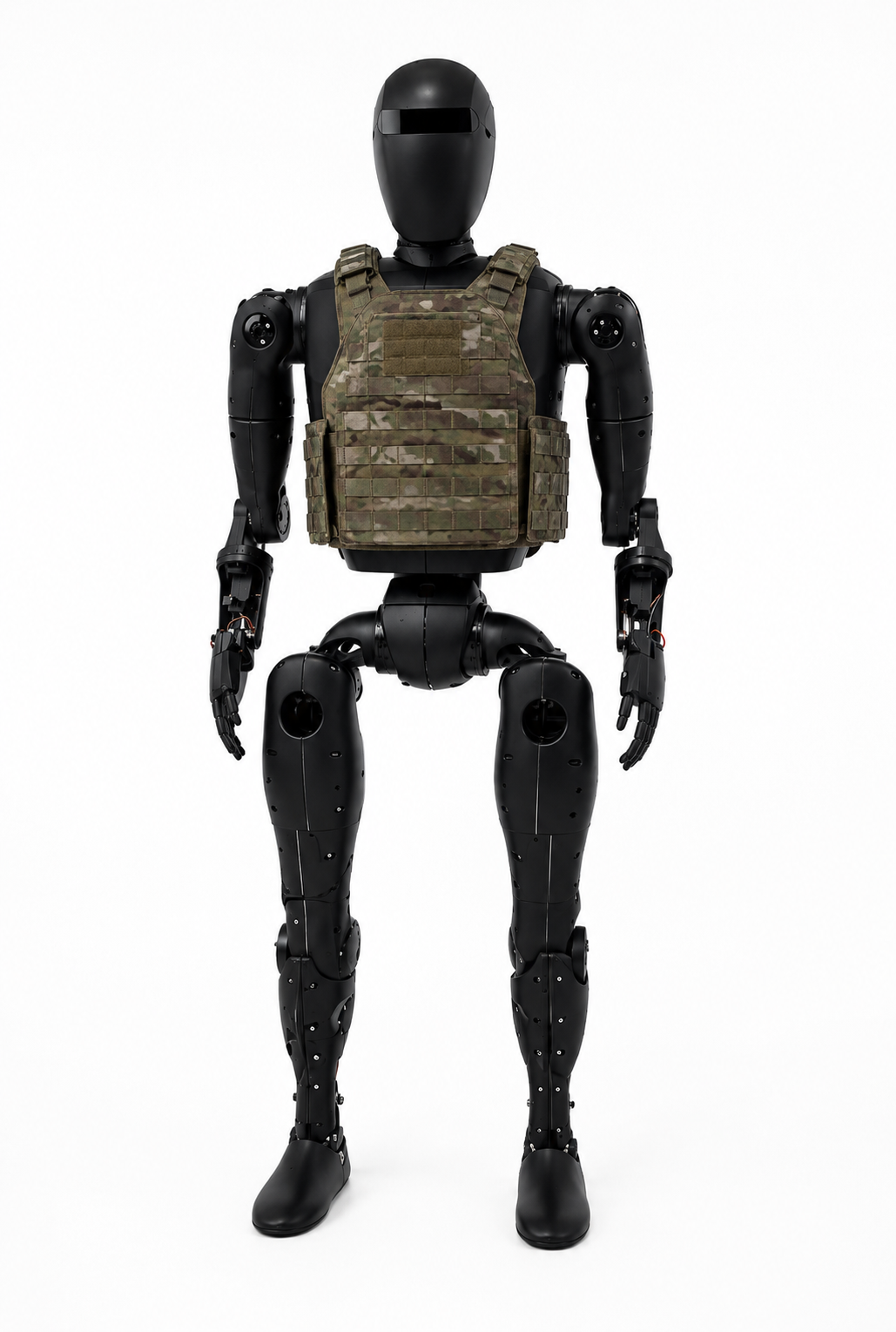
Titan Militarized Humanoid

Vision One Demo to US Marine General
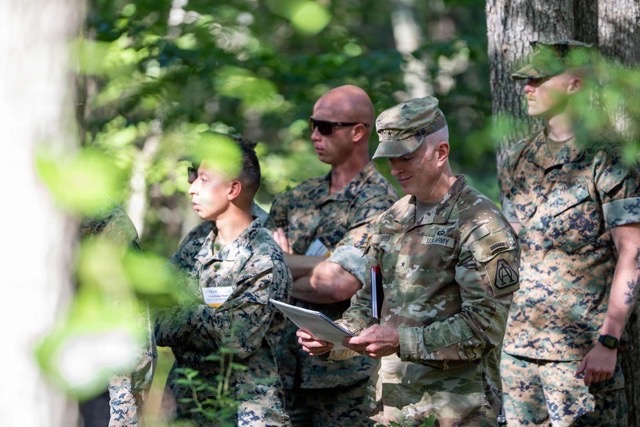
US Army General Observation
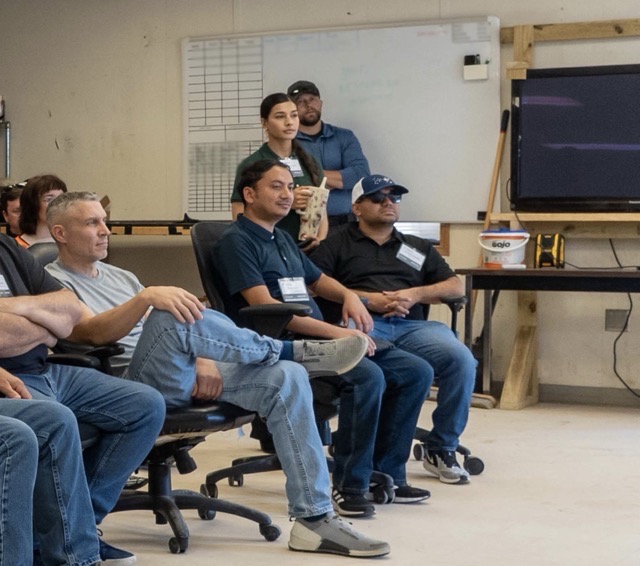
Team: Vision One
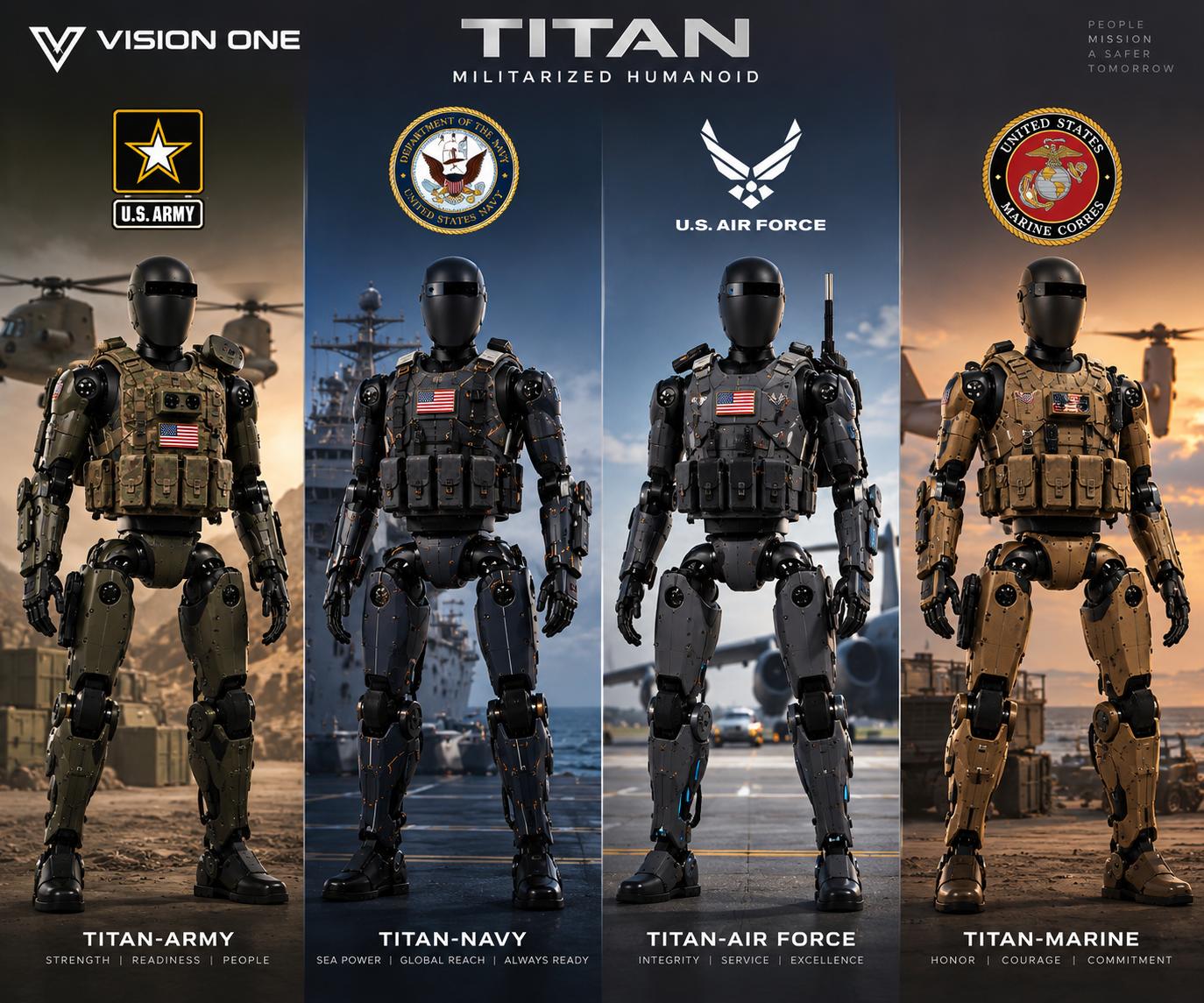
Militarized Humanoid for all US Military Branches
No Soldier Should Go Where a Machine Can Go First: Vision One’s TITAN Emerges as One of Two U.S. Army Baseline Humanoid Finalists From 100+ Applications
UT, UNITED STATES, September 30, 2026 /EINPresswire.com/ -- The future of warfare is changing rapidly. Artificial intelligence, drones, autonomous vehicles and robotic systems are moving from research laboratories into real military operations. Vision One believes the next major step will be humanoid machines capable of working alongside Soldiers and taking on missions where the risk to human life is simply too high.The principle behind the company’s TITAN militarized humanoid is simple:
Dangerous, difficult and life threatening jobs should increasingly be performed by machines when doing so can protect human life.
That does not mean removing people from military decision making. Vision One’s vision is almost the opposite: build machines capable of performing increasingly complex physical and cognitive tasks autonomously, while keeping human beings responsible for mission authority and consequential decisions.
TITAN recently reached a major milestone in that effort. Vision One was selected as one of the two companies in the Baseline Humanoid System finalist category of the U.S. Army’s xTechHumanoid competition. The Army says the overall competition attracted 103 white paper submissions covering complete humanoid systems and advanced humanoid subsystems. Ten companies advanced to the finals, and nine ultimately demonstrated their technologies at Marine Corps Base Quantico on September 9 and 10, 2026.
For Vision One, that achievement represents more than recognition of a robot. It represents an opportunity to help answer a much larger question:
If a machine can go first, why should a Soldier have to?
Building a Machine to Take the Risk
Military service will always involve risk. Technology cannot eliminate that reality. But throughout history, new technologies have changed how much danger people must physically endure to accomplish a mission.
Humanoid robotics could become another major step in that evolution.
Imagine a military unit approaching a building where the threat inside is unknown. Instead of immediately sending Soldiers through the door, a humanoid could enter first.
Imagine an area potentially contaminated by chemical or radiological hazards. A robotic system could investigate before personnel are exposed.
Imagine a dangerous reconnaissance route, a burning structure, an unstable building, an obstacle blocking movement or a location that may be under enemy observation. Instead of automatically putting a human being in the most exposed position, commanders could have another option.
Send the machine first.
This is the role Vision One is developing TITAN to perform.
The U.S. Army has described robotics and autonomy as technologies that can reduce Soldier exposure to dangerous and physically demanding tasks, preserve combat power and provide commanders with additional options. The Army created xTechHumanoid partly to establish a technical baseline and understand how emerging commercial humanoid technologies could contribute to future military operations.
TITAN is being developed around that same philosophy.
Potential missions include reconnaissance and surveillance, security, hazardous environment assessment, CBRNE reconnaissance, logistics and sustainment, firefighting support, maintenance, obstacle operations, unmanned aircraft employment and human machine teaming.
A humanoid form has another important advantage: the human world is already built for the human body.
Doors, stairs, tools, vehicles, equipment, buildings, warehouses and countless other systems were designed around human dimensions and movement. A capable humanoid could eventually interact with many of those environments without requiring the military to redesign everything around a specialized robot.
From the Battlefield to the Flight Line and Fleet
Vision One sees the U.S. Army and U.S. Marine Corps as the initial military users for TITAN, because their missions can place personnel directly into dangerous, physically demanding and complex environments. The humanoid form is especially important for these roles because military bases, buildings, vehicles, tools, equipment and infrastructure are largely designed around the human body. Rather than requiring an entirely new environment for a specialized robot, a militarized humanoid could eventually walk through doors, climb stairs, carry equipment, manipulate tools, conduct reconnaissance, inspect hazardous areas and support logistics alongside service members. As the technology matures, Vision One envisions applications across the other military services. For the U.S. Air Force, humanoids could support flight line operations, aircraft inspections, foreign object and damage detection, maintenance assistance, equipment handling, logistics and operations around hazardous aircraft systems. For the U.S. Navy, humanoids could support shipboard inspection, maintenance, machinery monitoring, damage assessment, firefighting support, cargo movement and work in confined or hazardous spaces. Similar robotic capabilities could support the U.S. Space Force with inspection and maintenance of remote infrastructure, while the U.S. Coast Guard could potentially employ humanoids for port, vessel, hazardous material and emergency response missions. Across the services, the objective remains the same: use the human form where the environment was built for humans, while allowing the machine to assume more of the danger, physical burden and repetitive work.
TITAN: An Intelligent Robotic Teammate
TITAN is not intended to be simply a remotely controlled mechanical body.
Vision One is developing the platform as an intelligent robotic teammate combining a human scale humanoid body with artificial intelligence, computer vision, autonomous navigation, environmental sensing, communications and interaction with other robotic systems.
Its sensors allow it to perceive the environment through multiple sources, including visual, thermal, depth, LiDAR, audio, navigation and environmental information.
Its artificial intelligence architecture is being developed to help interpret that information, understand assigned tasks, maintain situational awareness and support mission execution.
The goal is eventually to make interacting with a sophisticated robot much more natural.
Instead of an operator manually controlling every joint, step and movement, a Soldier could assign a mission or task. TITAN could then perform appropriate robotic actions within defined boundaries while reporting its status and observations back to the human operator.
A Soldier might tell TITAN to observe a designated area, investigate a hazard, monitor an approach, inspect a structure or conduct reconnaissance.
The robot could use its sensors to understand the environment, navigate, identify objects of interest and return information to the Soldier.
And when TITAN cannot see far enough, it could use another machine.
A Soldier, a Humanoid and a Drone
One of Vision One’s major development areas is integrating unmanned aircraft directly with the humanoid.
The concept is straightforward.
TITAN carries a small UAS. When additional reconnaissance is needed, the humanoid deploys and tasks the aircraft. The UAS can look over terrain, around buildings, onto rooftops or farther along a route. Information from the aircraft can then return to TITAN and the human operator.
Instead of thinking about a humanoid, drone and Soldier as three independent systems, Vision One sees them as members of the same connected team.
The Soldier provides intent and authority. The humanoid provides physical presence, sensing and robotic capability. The drone extends the team’s reach into the air.
The Army’s xTechHumanoid effort specifically includes advanced concepts involving humanoid controlled unmanned systems and humanoid deployed aerial sensors, making this an important area for continued development.
Autonomy Should Protect Humans, Not Remove Human Authority
As artificial intelligence becomes more capable, one of the most important questions is not simply how autonomous a machine can become.
The more important question is how autonomous it should become.
Military autonomy is better understood as a spectrum of human and machine responsibility rather than a simple universal numbered scale.
At the lower end, a human directly controls the machine. As autonomy increases, the machine can perform more tasks itself, such as navigation, obstacle avoidance, perception, route planning, sensor management and execution of assigned tasks.
At higher levels of supervised autonomy, the machine can perform complex sequences of actions within the mission, rules and boundaries established by humans.
Beyond that lies the concept of systems operating with increasingly limited or potentially no real time human involvement.
That final direction is not Vision One’s objective for TITAN.
Vision One is pursuing high supervised autonomy with human authority retained.
The robot should be intelligent enough to navigate around an obstacle without asking permission for every step. It should be able to monitor its sensors, maintain its balance, map its surroundings, identify hazards, manage routine tasks and respond to changing environmental conditions.
But consequential decisions, particularly decisions involving the use of force, should remain subject to appropriate human judgment and authority.
That approach is consistent with current Department of Defense policy requiring autonomous and semi autonomous weapon systems to be designed so commanders and operators can exercise appropriate levels of human judgment over the use of force.
Army professional literature similarly distinguishes between human in the loop, where people directly participate in decisions and actions, and human on the loop, where autonomous systems perform authorized functions while humans supervise them.
For TITAN, the goal is therefore not to create a science fiction machine independently deciding who is an enemy and what wars it should fight.
The goal is to create an intelligent robotic teammate capable of doing difficult work while remaining under human mission authority.
The machine takes more of the physical risk. The human retains responsibility for the decisions that matter.
A Real World Glimpse of What Robotics Can Mean
The value of that philosophy is already becoming visible elsewhere in the U.S. military.
In June 2026, an unmanned U.S. Navy surface vessel was used in the rescue of two U.S. Army crew members after an Apache helicopter went down near the Strait of Hormuz. The robotic vessel recovered the personnel and became part of the chain that brought them safely out of the water.
The importance of that event goes far beyond one unmanned boat.
It demonstrated a basic principle of military robotics: a machine can be sent into an operational environment to perform a dangerous mission without putting another crew aboard that machine.
Vision One wants to help bring that principle onto land.
A humanoid could one day enter a hazardous building, investigate a contaminated location, conduct reconnaissance, transport equipment through dangerous terrain or approach an uncertain environment while Soldiers remain farther from the immediate threat.
Different machine. Same objective.
Protect human life whenever technology provides another option.
The next development phase will focus heavily on mobility and manipulation, power endurance, environmental protection, system reliability, extended range perception, advanced sensing, and deeper integration with unmanned aircraft and other robotic systems.
Vision One also plans to continue improving TITAN’s ability to understand mission information, navigate complex environments, and work collaboratively with humans and machines.
The objective is not simply to build a robot that looks human.
The objective is to build a machine that can perform useful human-scale work in places where sending a person creates unnecessary danger.
The Same Technology Could Save Civilian Lives
The potential impact extends far beyond military operations.
Many civilian professions involve the same fundamental problem: people must enter dangerous environments because there is currently no capable machine to take their place.
Natural disasters provide an obvious example.
After an earthquake, rescue personnel may have to enter buildings that could collapse again. During wildfires, firefighters operate around extreme heat, smoke, and hazardous gases. Industrial accidents may expose responders to chemicals or damaged infrastructure. Floods, hurricanes and explosions can create environments filled with debris, electrical hazards and unstable structures.
A civilian TITAN could eventually enter some of these environments first.
A humanoid could search a damaged building, map an interior, use thermal imaging to help locate people, measure environmental hazards, transport emergency supplies or transmit information to rescue personnel outside.
The same principle applies:
Do not unnecessarily send a human into danger when a machine can perform the first assessment.
From Emergency Response to the Home
As humanoid technology becomes safer, more reliable and more affordable, its role could eventually expand into everyday life.
An aging population will increasingly need assistance with ordinary physical tasks.
A future civilian humanoid could help an older person retrieve objects, carry groceries, perform basic household tasks, monitor for emergencies or summon assistance after a fall or medical event.
For some families, robotics could eventually provide something more valuable than convenience: the ability for an older family member to remain independent longer.
Military service, disaster response and elder care may seem like completely different applications. Yet they share a common technological goal.
Build machines that can operate in environments designed for humans and use those machines to reduce physical danger, burden and hardship.
The Future Is Human and Machine Together
The emergence of humanoid robotics does not have to mean choosing between humans and machines.
The U.S. Army has itself described future autonomy in terms of integration rather than replacement. Autonomous systems can extend reach and reduce risk, while humans contribute judgment, adaptability, responsibility and understanding that machines cannot simply replace.
That is also the future Vision One sees for TITAN.
A machine capable enough to enter the danger.
A machine intelligent enough to understand its assigned task.
A machine autonomous enough to operate without someone controlling every movement.
But a machine that ultimately serves human objectives under human authority.
Vision One’s selection as one of the Baseline Humanoid System finalists in a U.S. Army competition that attracted more than 100 submissions represents an early step toward that future.
There is still significant engineering ahead before humanoids can routinely accompany Soldiers, firefighters or rescue teams into the world’s most difficult environments.
But the purpose of developing them is already clear.
The ultimate success of TITAN will not be measured by how closely a machine can imitate a human being.
It will be measured by how many dangerous jobs a machine can perform so a human being does not have to.
No Soldier should have to go where a machine can go first. No firefighter should have to enter danger simply because there is no alternative. And no technological advance is more meaningful than one that helps bring another human being home safely.
Pranisha Karki
Vision One
+1 682-298-4272
email us here
Visit us on social media:
LinkedIn
Legal Disclaimer:
EIN Presswire provides this news content "as is" without warranty of any kind. We do not accept any responsibility or liability for the accuracy, content, images, videos, licenses, completeness, legality, or reliability of the information contained in this article. If you have any complaints or copyright issues related to this article, kindly contact the author above.
